
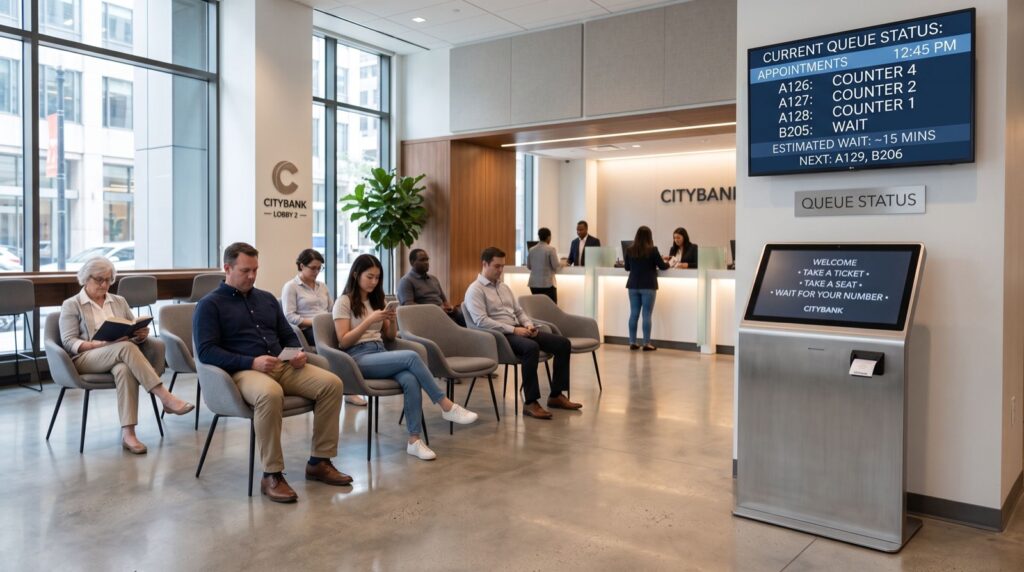
Picture a branch lobby in Riyadh at 11 a.m. on a Sunday. Forty people hold paper tickets. A third of them have been standing because the seats ran out. Two are at the wrong counter entirely and will discover this only after twenty-five minutes of waiting. Nobody on the staff side can say, with data, how long the average visitor has been there. Now ask the uncomfortable question: how much revenue, goodwill, and staff energy did that single morning burn?
Waiting has a price, and in the Kingdom that price is rising. Saudi consumers have been retrained by super-apps, instant delivery, and digital government services to expect that their time will be respected. Vision 2030 has pushed customer experience from a slogan to a board-level metric across banking, healthcare, telecom, and retail. Against that backdrop, an unmanaged queue is no longer a minor inconvenience — it is a public statement that an organization has not modernized.
The Arithmetic Nobody Runs
Managers tend to see queues as a staffing problem: add more counters, waits shrink. But the real losses hide elsewhere. Walk-aways are the first casualty — the customer who glances at the crowd, turns around, and completes the transaction with a competitor’s app instead. Then come the misrouted visitors who consume a teller’s time only to be redirected, effectively doubling their service cost. Finally there is the staff toll: employees facing a visibly irritated crowd make more errors and burn out faster.
None of these appear on a P&L under the heading “waiting.” They surface as softer conversion numbers, higher churn, and rising HR complaints, which is precisely why the problem survives budget cycle after budget cycle.
What Modern Queuing Actually Looks Like
The paper-ticket dispenser bolted to a wall is queue management the way a cash box is accounting. A contemporary queue management system in saudi arabia looks fundamentally different: visitors check in from their phone before leaving home, receive a live estimate of their wait, get routed to the right service desk based on what they need, and are called by name on a display and an SMS at the same moment. Behind the scenes, managers watch a dashboard showing wait times per service type, per counter, per hour — and can rebalance staff before the lobby fills rather than after.
The Difference Data Makes
Once every visit is timestamped from arrival to completion, patterns emerge that intuition misses. Perhaps Tuesdays after Dhuhr are your true peak, not Sunday mornings. Perhaps one service category takes triple the time it was budgeted for. Organizations that measure waiting can redesign it; organizations that do not are guessing with other people’s time.
A Five-Step Path for Getting It Right
Deployments fail more often from sequencing than from software. Institutions across the Gulf that have done this well tend to follow the same order of operations:
- Baseline the pain first. Spend two weeks recording actual wait times, walk-away counts, and misrouting incidents at your busiest branch. Without a “before,” you can never prove the “after.”
- Map services, not counters. List every reason a customer visits, then decide which need a specialist, which any agent can handle, and which should be pushed to self-service entirely.
- Pilot one location. Choose a mid-sized branch, not the flagship. You want honest results and room to make mistakes quietly.
- Train for the conversation, not the screen. Staff need scripts for the new flow — greeting pre-checked-in visitors, handling elderly customers who prefer paper tickets, escalating when estimates slip.
- Publish the numbers internally. When branch managers see wait-time league tables monthly, improvement stops depending on head-office pressure.
The pattern here mirrors advice from an unexpected domain: personal finance writers and reliable local experts keep repeating that small, consistent, measured habits beat dramatic one-off gestures. Queues obey the same law. A branch that trims ninety seconds off its average wait every quarter will, within two years, feel like a different institution.
When the Queue Moves Outdoors
Saudi Arabia adds a variable most queue theory ignores: summer. For five months of the year, any process that keeps people out of their cars is a competitive weapon, which explains why the Kingdom has become one of the fastest-adopting markets for car-lane service formats — not only in fast food but in pharmacies, coffee chains, and even document collection. Providers of Drive Thru Solutions are, in effect, selling climate-proof queue management: the customer waits in air conditioning, the “lobby” becomes a lane with a measurable service time, and throughput can be timed to the second.
The lesson for service businesses is to stop thinking of the drive-thru as a restaurant gimmick. Any transaction that takes under four minutes and requires no signature on paper is a candidate for the lane. Several Saudi banks have already experimented with drive-up services for card collection and cheque deposit; expect that list to grow.
Objections Worth Answering
“Our customers prefer the personal touch.” Nothing about virtual queuing removes the human interaction — it removes the standing around before the interaction. The teller conversation is unchanged; the forty minutes of ambient frustration preceding it are gone.
“We already added more staff at peak times.” Staffing treats the symptom at the most expensive possible point. Routing, pre-check-in, and self-service reduce the number of visitors who need a counter at all, which is structurally cheaper than adding counters forever.
“The older generation will struggle.” Well-designed systems run dual-mode: a touch kiosk with Arabic-first design and a printed token for those who want it, phone check-in for those who do not. Adoption data across the region shows the paper share shrinking on its own within months, without anyone being forced.
The Standard Is Being Set Now
Every market goes through a window in which superior service operations are still a differentiator rather than a baseline. Saudi Arabia is in that window today. The banks, clinics, and retailers deploying serious queuing infrastructure now are buying more than software — they are training their customers to expect better, and quietly making every competitor’s lobby feel older by comparison.
So the twenty-minute wait is not really a twenty-minute problem. It is a compounding one, paid daily, in the only currency customers never get back. The organizations that respect that currency will own the next decade of Saudi customer experience. The ones that keep printing paper tickets will keep wondering why the lobby feels emptier each year.